Building Trust in LGBTQ+ Patients Starts Before the Assessment
June 16, 2026 | 4 min read

This is the second part in a two-part Pride Month series on recent LGBTQ+ research, healthcare disparities, and respiratory care.
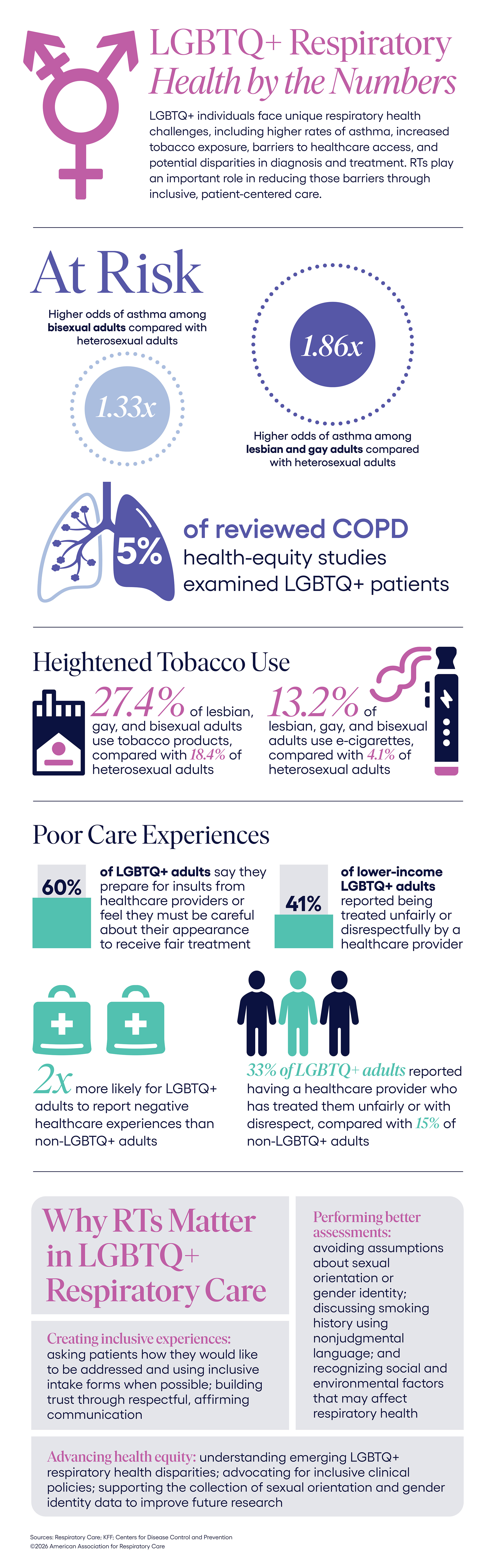
Creating a friendly environment begins long before a respiratory assessment or pulmonary function test, and visual cues can go a long way to establish that welcoming space, according to the American Medical Association. Those efforts can include:
- Displaying brochures, symbols, and educational material about LGBTQ+ health concerns, which can include LGBTQ+ flags or stickers, posters of LGBTQ+ couples, or having LGBTQ+ specific magazines in the waiting room
- Visibly posting a nondiscrimination statement
- Showcasing posters from nonprofit LGBTQ+ organizations
Inclusive intake forms are another helpful step, allowing patients to report their gender identity, chosen name, and pronouns, signaling that the healthcare organization recognizes and respects diverse identities. The Fenway Institute has a sample intake form that, among other guidance, includes language on how to navigate collecting someone’s legal sex alongside their preferred names and pronouns.
These are important steps since research has consistently found that LGBTQ+ individuals may delay or avoid healthcare because of prior negative experiences, discrimination, or concerns about stigma. The Respiratory Care asthma study, for instance, notes that disparities among sexual minority populations may be influenced by “poor quality of care, unfair treatment, and discrimination” when receiving medical services.
Other simple practices can further build trust:
- Asking patients how they would like to be addressed.
- Using inclusive language when discussing relationships and support systems.
- Avoiding assumptions about sexual orientation or gender identity.
These actions may seem small, but they can significantly affect whether patients feel comfortable sharing information relevant to their respiratory health.
Inclusive Communication During Respiratory Assessments
Respiratory assessments often involve conversations about smoking history, environmental exposures, medications, symptoms, and lifestyle factors.
Because smoking rates have historically been higher among LGBTQ+ populations, clinicians may be tempted to make assumptions about tobacco use. However, patient-centered care requires asking open-ended questions rather than relying on stereotypes.
Using neutral, nonjudgmental language encourages more open patient communication and helps RTs gather the information necessary to develop appropriate care plans.
Inclusive Care and Clinical Accuracy
Pulmonary function testing presents a unique challenge when caring for transgender and gender-diverse patients.
In a 2018 Respiratory Care study, researchers evaluated how spirometry interpretation changed when predicted values were calculated using a patient’s gender identity rather than sex assigned at birth. The results showed that using non-birth sex affected spirometry interpretation in 45% of participants assigned male at birth and 70% of participants assigned female at birth.
The authors concluded that using non-birth sex to calculate predicted values “may have a significant impact on test interpretation and place these patients at risk for misdiagnosis and inappropriate treatment. Spirometry testing can be conducted with physiologic accuracy without violating a patient’s right to gender identity.”
The study does not suggest disregarding a patient’s gender identity, either. “Failure to recognize a patient’s right to determine their gender identity can cause significant emotional and psychological harm and may discourage patients from accessing needed medical care.”
Instead, the authors recommend an advocate-approved two-step process that records both sex assigned at birth and gender identity to preserve clinical accuracy while respecting patient identity. Another option, they write, is to create transgender predicted equations. “The transgender predicted equation would simply be an existing equation calculated with birth sex but linked to the patient’s gender identity.”
For a transgender woman, for instance, “the technologist would enter female into the patient demographics but would select the transgender predicted equation calculated with birth sex. We believe that the transgender predicted equation strategy would accomplish the same goals as the [two-step] approach.”
The authors added that a universally adopted solution must eventually be achieved.
Why Affirming Care Matters
Patients who feel respected are more likely to seek care, discuss symptoms openly, participate in follow-up appointments, and engage in long-term disease management. This is particularly important for chronic respiratory conditions that require ongoing monitoring and support.
As the COPD inequities review demonstrates, substantial gaps remain in understanding how social determinants and healthcare experiences affect LGBTQ+ individuals living with respiratory diseases. Until those gaps are addressed, respiratory therapists can play an important role in reducing barriers by using inclusive communication, avoiding assumptions, staying informed about emerging research, and creating environments where patients feel safe and respected.
“There is great power working in community with the people who need our help,” Keuroghlian said. “As clinicians and health researchers, we have a responsibility to use our privilege, experience, and expertise to help counter disinformation, shape the public discourse, and work with policymakers to advance health equity for all people.”
AARC
Related Articles
Explore our recent posts below.

ICS During Pregnancy Does Not Raise Maternal or Neonatal Risks
Guidelines recommend that women with asthma continue using their inhaled cortico…

Over Reliance on Reliver Inhalers May Up Cardiovascular Risk
Asthma and COPD patients who depend too heavily on short-acting bronchodilators…

AI’s Value and Limitations in Clinical Respiratory Care
As more respiratory technology incorporates artificial intelligence, questions a…
ICS During Pregnancy Does Not Raise Maternal or Neonatal Risks
Guidelines recommend that women with asthma continue using their inhaled cortico…
Over Reliance on Reliver Inhalers May Up Cardiovascular Risk
Asthma and COPD patients who depend too heavily on short-acting bronchodilators…
AI’s Value and Limitations in Clinical Respiratory Care
As more respiratory technology incorporates artificial intelligence, questions a…

New Flu Vaccine in the Works
Researchers from the University of Michigan Engineering believe they have discov…
The next step of your respiratory therapist journey begins now.
The AARC can help you discover your unique path and connect you with thousands of other dedicated RTs.